%20.png)
.png)
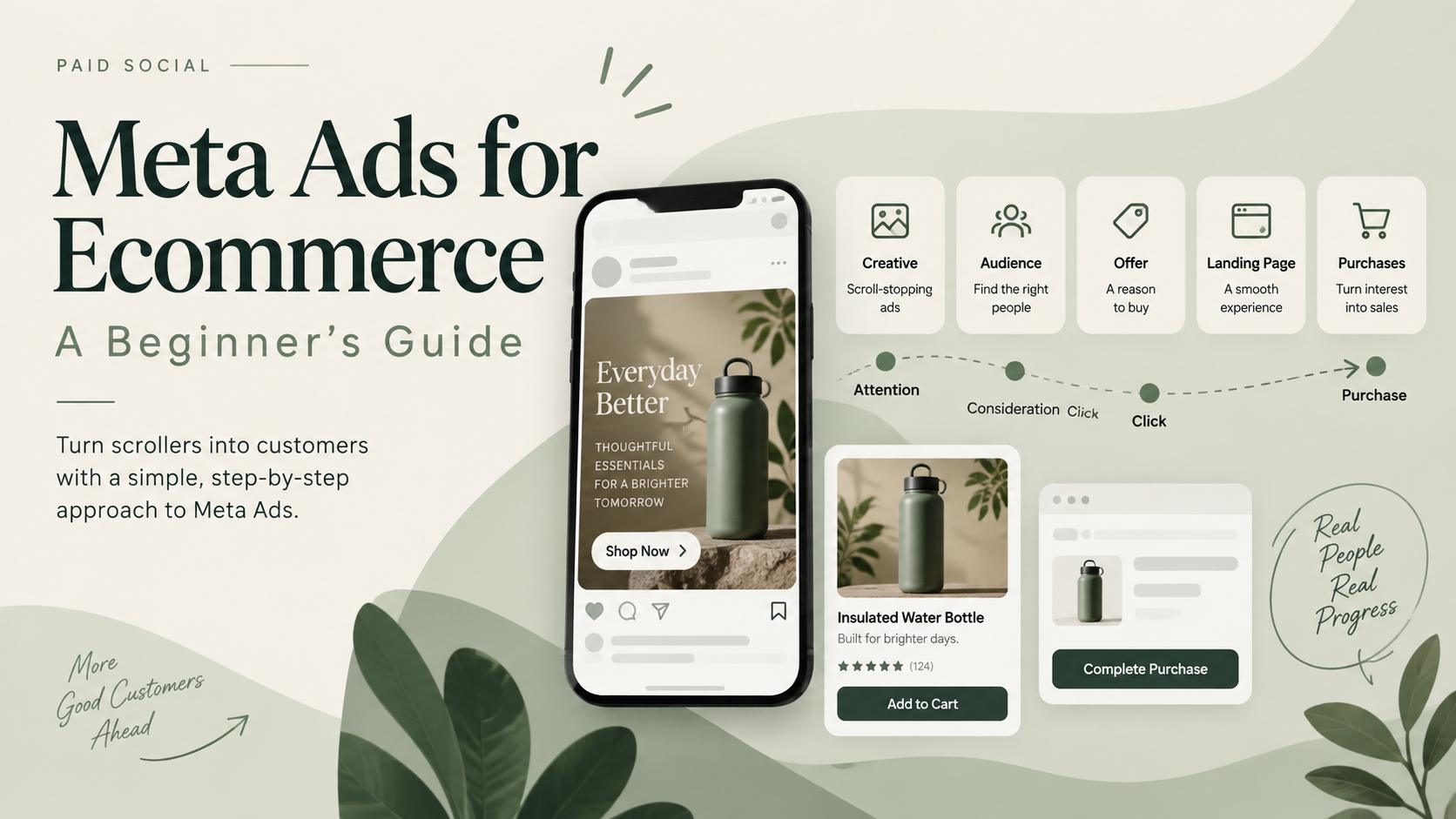
Meta Ads can be one of the most effective ways for ecommerce brands to create demand, introduce products to new customers, and scale beyond people who are already searching for the brand.
That makes Meta fundamentally different from a channel like Google Search.
Google often captures existing intent.
Meta frequently has to create it.
Someone scrolling Instagram may not be actively searching for a new skincare product, pair of shoes, or coffee subscription. Your ad has to interrupt that scroll, make the product relevant, and give the customer a reason to care.
That is why strong Meta advertising usually depends on more than targeting.
Creative matters.
The offer matters.
The product matters.
The landing page matters.
Conversion rate matters.
And the economics of acquiring the customer matter.
For growing ecommerce brands, the goal is not simply to “run Facebook ads.”
It is to build a paid social system that can reliably turn attention into profitable customers.
What are Meta Ads?
Meta Ads are paid advertisements that run across Meta’s advertising ecosystem, including Facebook, Instagram, Messenger, and other eligible placements.
For ecommerce brands, Meta Ads can be used to:
- introduce products to new customers
- generate website traffic
- drive purchases
- remarket to previous visitors
- promote specific products or collections
- use product catalogs for dynamic ads
- test new creative and offers
- expand into new audiences
For Shopify merchants, products can also be synced into Meta through Shopify’s Facebook and Instagram sales channel, creating a shared product catalog for Facebook and Instagram. Shopify’s Facebook and Instagram by Meta documentation
The important thing to understand is that Meta does not work like a traditional keyword-driven advertising channel.
You are not simply waiting for someone to search for the product.
You are trying to earn their attention.
How Meta Ads work for ecommerce
Imagine you sell premium running shorts.
A potential customer is scrolling Instagram.
They are not searching for running shorts.
They see a short video showing:
- the shorts during a long run
- the phone pocket
- the lightweight fabric
- the lack of chafing
- the product on different body types
The ad gets their attention because it connects the product to something they care about.
They click.
They land on the product page.
They read reviews, check sizing, understand shipping, and buy.
That customer journey depends on several pieces working together:
creative → product → offer → landing page → conversion → economics
If one of those pieces is weak, performance usually suffers.
The five parts of Meta Ads beginners should understand first
1. Campaign objective
Meta needs to know what outcome you are trying to generate.
For ecommerce brands, purchases are usually the ultimate objective.
That sounds obvious, but the platform optimizes based on the signals and goals you give it.
If the goal is purchases, Meta needs reliable purchase data.
If the tracking is wrong or you optimize toward weak proxy events, the platform can end up pursuing behavior that looks active without creating enough revenue.
The objective should match the business outcome as closely as possible.
2. Creative
Creative is one of the biggest performance levers in paid social.
Unlike Google Search, where a user may already be actively looking for the product, Meta often has to create enough interest for the shopper to stop scrolling.
That means creative needs to answer questions quickly:
- What is this?
- Why should I care?
- Who is it for?
- What makes it different?
- Why should I buy now?
Strong ecommerce creative can take many forms:
- product demonstrations
- testimonials
- founder-led videos
- customer-style content
- before-and-after use cases where appropriate
- static product images
- carousels
- lifestyle imagery
- problem-and-solution ads
- offer-focused creative
There is no single best format for every brand.
The important thing is to test meaningful ideas, not 20 versions of the same ad with a different headline color.
Related: Ecommerce Creative Testing: What to Test Before You Blame Targeting
3. Audience and delivery
Meta uses a large number of signals to decide who should see an ad.
Advertisers can still provide audience inputs, exclusions, geographic constraints, and other campaign settings, but Meta has increasingly automated large parts of delivery.
For ecommerce advertisers, that means trying to outsmart the platform with endless audience segmentation is often less important than it used to be.
That does not mean targeting is irrelevant.
It means creative, product appeal, offer, and conversion quality often matter more than finding one secret audience.
The better question is not:
“What interest should we target?”
It is:
“Can Meta identify people likely to buy if we give it strong enough signals and compelling enough creative?”
4. The landing page
The ad earns the click.
The website has to earn the purchase.
A common mistake is treating Meta performance as something that happens entirely inside Ads Manager.
It does not.
If the ad promotes a specific product and the customer lands on a generic homepage, the journey becomes harder.
If the product page is confusing, slow, poorly merchandised, or missing important information, the campaign will eventually pay for that weakness.
A strong landing experience should maintain continuity with the ad.
If the ad talks about:
“The lightweight travel backpack built for weekend trips”
the landing page should make that same product, benefit, and positioning immediately obvious.
Related: Ecommerce Landing Page Optimization: Turning Paid Traffic Into Revenue
5. Measurement
Meta needs good data to optimize.
The business needs good data to decide whether Meta is actually working.
Those are related, but they are not exactly the same problem.
Shopify allows merchants to connect a Meta Pixel through its Facebook and Instagram by Meta integration. Shopify currently offers different customer data-sharing levels and warns merchants to avoid duplicate pixel implementations because duplicate tracking can produce incorrect reporting. Shopify’s Meta Pixel documentation
Measurement should be treated as infrastructure.
Not something to check only when results look strange.
What is the Meta Pixel?
The Meta Pixel is a tracking mechanism that helps Meta understand actions customers take on the website.
That can include events such as:
- page views
- product views
- add to cart
- checkout activity
- purchase
Meta can use those signals to improve campaign optimization and reporting.
For Shopify merchants, the Pixel can be connected directly through the Facebook and Instagram by Meta sales channel. Shopify’s Meta Pixel setup guide
One important implementation detail:
Do not install the same Pixel multiple ways without understanding what is being sent.
Shopify specifically notes that duplicate Pixel implementations can cause duplicate or incorrect data.
What is the Conversions API?
The Conversions API is another way of sending customer and conversion information to Meta.
Rather than relying only on browser-based activity, server-side data can provide additional signals.
For Shopify merchants, some of this functionality is handled through Shopify’s customer data-sharing settings when Facebook and Instagram by Meta is connected. Shopify documents that its higher data-sharing levels can use the Conversions API as part of the integration. Shopify’s Facebook and Instagram by Meta documentation
For a beginner, the practical lesson is simple:
Make sure tracking is configured correctly before making aggressive decisions based on campaign data.
What are Advantage+ campaigns?
Meta uses the Advantage+ name for a number of automated advertising features.
The general direction is straightforward:
Meta is automating more of the delivery, audience, placement, and creative decision-making inside campaigns.
For ecommerce brands, this shifts the advertiser’s role.
The question becomes less:
“How many tiny audience segments should we build?”
And more:
“Are we giving Meta good conversion data, strong creative, the right products, and enough budget to optimize?”
Automation can make campaign management simpler.
It does not fix weak fundamentals.
A poor product with weak creative and a bad landing page does not become a good acquisition system because the campaign uses more automation.
Prospecting vs remarketing
One of the first concepts ecommerce advertisers encounter is the difference between prospecting and remarketing.
Prospecting
Prospecting is focused on reaching people who may not have interacted with the brand before.
The objective is customer acquisition.
Creative usually has more work to do because the audience may know very little about the company.
Remarketing
Remarketing focuses on people who have already interacted with the business.
That might include:
- website visitors
- product viewers
- cart abandoners
- previous customers
- people who engaged with content
Shopify currently documents Meta dynamic retargeting ads that can use catalog and Pixel activity to show relevant products to previous store visitors. Shopify’s dynamic retargeting documentation
Remarketing can look highly efficient because the audience already has some familiarity or intent.
That is useful.
But it should not be confused with new-customer acquisition.
Why creative matters so much on Meta
Creative is the bridge between a person who was not thinking about your brand and a person who is now considering buying.
That is a difficult job.
Strong creative can help customers quickly understand:
- the product
- the problem
- the benefit
- the differentiation
- the use case
- the proof
- the offer
Weak creative often fails before targeting even gets a chance to matter.
A sophisticated campaign pointed at mediocre creative is still a mediocre campaign.
For ecommerce, useful creative angles might include:
Product demonstration
Show the product doing the thing it is designed to do.
Customer problem
Start with the frustration the customer already recognizes.
Social proof
Use actual customer feedback where appropriate.
Product comparison
Explain what makes the product materially different from alternatives.
Objection handling
Answer concerns around price, quality, sizing, shipping, ease of use, or durability.
Founder explanation
For founder-led brands, a clear explanation of why the product exists can be effective when it is authentic and useful.
The best creative testing program learns about customers.
It does not simply generate more ads.
Meta Ads and product catalogs
Shopify merchants can sync products into Meta through the Facebook and Instagram by Meta channel.
Shopify says products made available through the channel can sync into the Meta product catalog used across its Facebook and Instagram commerce features. Shopify’s product publishing guide
This matters because catalog-based advertising can help Meta dynamically promote relevant products.
For retailers with larger catalogs, this can become an important part of both prospecting and remarketing.
But the same commercial question still applies:
Should every product receive equal advertising support?
Usually not.
Products vary in:
- margin
- inventory
- conversion rate
- price
- customer appeal
- repeat behavior
- return rate
- ability to acquire new customers
The catalog is not just a technical feed.
It represents the assortment the media system is trying to sell.
How much should ecommerce brands spend on Meta Ads?
There is no universal starting number.
A brand should not choose its Meta budget because another ecommerce founder said they spend 15% of revenue.
The budget should reflect:
- customer acquisition economics
- conversion rate
- AOV
- margin
- cash flow
- creative capacity
- audience size
- business stage
- learning requirements
A useful distinction is between testing and scaling.
Testing budget
A testing budget is designed to answer questions.
Can this product acquire customers?
Does this creative concept work?
Does this offer generate stronger purchase intent?
Scaling budget
A scaling budget is designed to increase volume while keeping economics acceptable.
Those are not the same thing.
A campaign that works at $200 per day may not maintain the same CAC at $1,000 per day.
As spend increases, Meta often needs to reach broader or less obvious opportunities.
That is why marginal performance matters.
Related: How Much Should an Ecommerce Brand Spend on Paid Advertising?
What metrics should ecommerce brands watch?
Meta reports many metrics.
Beginners do not need to obsess over all of them.
Focus on the metrics that help explain whether the system is producing commercially useful customers.
Purchases
How many purchases were attributed to the campaign?
Revenue
How much purchase value was attributed to Meta?
ROAS
How much attributed revenue was generated relative to spend?
If you spend $10,000 and Meta reports $40,000 in purchase revenue, reported ROAS is 4x.
Useful.
Not complete.
CAC
How much does it cost to acquire an actual new customer?
This can be more important than total attributed revenue for brands with substantial repeat purchasing.
Conversion rate
What percentage of visitors buy after reaching the site?
Weak conversion can put a ceiling on Meta performance even when creative and traffic quality are good.
AOV
How much does the average order generate?
A higher AOV can create more room for acquisition spend, assuming margin remains healthy.
Contribution margin
How much is left after product costs and other variable costs?
Revenue without margin is an incomplete growth story.
New-customer revenue
How much of the revenue comes from actual acquisition rather than existing customers?
That distinction becomes increasingly important as the business matures.
What about CPM, CTR, and CPC?
They are useful diagnostic metrics.
They should not become the business objective.
CPM
Cost per thousand impressions.
This tells you what it costs to buy attention.
CTR
Clickthrough rate.
This tells you how frequently impressions generate clicks.
CPC
Cost per click.
This tells you what each click costs.
Those metrics can help diagnose creative and delivery.
But a cheap click that never buys is not inherently valuable.
A more expensive click that converts profitably can be excellent.
That is why channel metrics should always reconnect to ecommerce outcomes.
Why Meta and Shopify may report different revenue
This is normal enough that every growing ecommerce brand eventually encounters it.
Meta says one number.
Shopify says another.
Why?
Because attribution is not simply transaction accounting.
A customer may interact with multiple channels before buying.
For example:
- They see an Instagram ad.
- They visit the website.
- They leave.
- They click a Google Shopping ad two days later.
- They return directly and purchase.
Meta may see an interaction it believes deserves credit.
Google may see another.
Shopify records the actual order and applies its own reporting logic.
The platforms do not necessarily see the same journey in the same way.
That is why Wild Mushroom generally views platform reporting alongside business-level metrics.
Related: Ecommerce Attribution: Why Google Ads, Meta and Shopify Never Agree
What makes Meta Ads perform well?
There is no single lever.
Strong performance usually comes from several things working together.
A product people actually want
Advertising amplifies demand.
It does not permanently manufacture product-market fit.
Strong creative
The ad has to earn attention and communicate value.
A compelling offer
Price, bundles, shipping, guarantees, and promotions can materially change response.
A good landing experience
The website needs to finish the selling job.
Healthy conversion rate
Better conversion gives the business more room to compete for traffic.
Acceptable economics
A campaign cannot scale responsibly if the cost of acquiring customers exceeds what the business can support.
Enough creative variation
A few ads can only carry a scaling program so far.
Common Meta Ads mistakes ecommerce brands make
Obsessing over targeting
Targeting is part of the system.
It is not the whole system.
If performance is poor, investigate creative, offer, conversion, product appeal, and economics before assuming you need another audience.
Running the same creative for too long
Creative can lose effectiveness over time.
A healthy program continuously develops new concepts rather than waiting for performance to collapse.
Testing tiny variations instead of big ideas
Testing:
blue background vs beige background
may teach you very little.
Testing:
customer testimonial vs direct product demonstration
can reveal something meaningful about why people buy.
Sending everyone to the homepage
Make the destination relevant to the ad.
Judging the channel entirely on ROAS
Reported ROAS can be influenced by remarketing, returning customers, and attribution.
Also review new-customer acquisition and blended business performance.
Scaling before the economics work
More spend does not turn an unprofitable acquisition model into a profitable one.
Fragmenting the account unnecessarily
More campaigns and more audiences can create more complexity without producing more useful control.
Structure should solve a problem.
Why Meta Ads stop scaling
Scaling makes weaknesses more visible.
At low spend, one strong creative concept may carry an account.
At higher spend, that concept needs to reach more people more frequently.
Performance can deteriorate because:
- creative fatigue increases
- the audience becomes less responsive
- conversion rate cannot support higher acquisition costs
- the offer stops being compelling enough
- the available demand is smaller than expected
- landing-page friction becomes more expensive
- the economics simply do not support more volume
When that happens, the solution may not be another campaign setting.
Related: Why Your Meta Ads Aren’t Scaling
What should an ecommerce beginner set up first?
A practical sequence looks like this.
Step 1: Confirm the business is ready for paid acquisition
Review:
- product-market fit
- conversion rate
- margin
- inventory
- average order value
- website quality
- offer
Paid traffic makes existing problems more expensive.
Step 2: Set up Meta business assets correctly
For Shopify brands, connect the appropriate Facebook and Instagram assets and ensure the correct ad account and catalog are associated with the store.
Shopify documents the current setup process for its Facebook and Instagram by Meta sales channel, including connecting the relevant Meta business assets. Shopify’s setup guide
Step 3: Configure measurement
Connect the Meta Pixel and appropriate data-sharing settings.
Check for duplicate tracking.
Step 4: Sync the catalog where relevant
Make sure the products you intend to advertise are properly represented in the Meta catalog.
Step 5: Build multiple strong creative concepts
Do not launch with one ad and call it a test.
Create genuinely different messages.
Step 6: Optimize toward purchases when purchases are the goal
Keep the optimization event as closely aligned with business value as practical.
Step 7: Send traffic to relevant pages
Match the post-click experience to the ad.
Step 8: Measure customer economics
Look beyond Meta’s interface.
Review Shopify revenue, CAC, AOV, conversion rate, new customers, and contribution.
Step 9: Scale when the system earns it
Increase spend when the economics and operational capacity justify more volume.
Is Meta Ads right for every ecommerce brand?
No.
Meta tends to be particularly attractive when:
- the product can be understood visually
- the brand has strong creative potential
- the offer is compelling
- conversion rate is healthy
- customer economics support paid acquisition
- the category has enough audience breadth
- the business can consistently produce creative
It can be harder when:
- the product requires extensive explanation
- the value proposition is unclear
- the product is visually difficult to demonstrate
- margins are too thin
- conversion is weak
- there is no creative production capacity
- the business expects targeting to compensate for weak demand
Sometimes the right answer is to fix the website.
Sometimes it is to improve the offer.
Sometimes it is to improve creative.
Sometimes it is to invest more aggressively in Meta.
The important thing is diagnosing the actual constraint.
Meta Ads should be managed as part of the ecommerce business
It is easy to spend all day inside Ads Manager.
Campaigns.
Ad sets.
Audiences.
Placements.
Budgets.
ROAS.
But customers do not experience Ads Manager.
They experience:
the product, the ad, the landing page, the offer, the checkout, and the brand.
Meta performance is the output of that system.
The best paid social programs therefore connect media decisions to:
- creative
- conversion rate
- product positioning
- merchandising
- AOV
- CAC
- contribution margin
- customer value
Targeting matters.
Campaign structure matters.
But neither can permanently compensate for a weak ecommerce proposition.
Ready to make Meta Ads a more predictable growth channel?
Wild Mushroom helps ecommerce brands turn paid social into a more disciplined growth system.
We look beyond account settings to the things that actually shape acquisition performance: creative, offer, landing-page alignment, conversion rate, customer economics, product mix, measurement, and budget allocation.
If your brand has proven demand but Meta still feels inconsistent, difficult to scale, or too dependent on a handful of ads, explore Wild Mushroom’s Paid Social services for ecommerce brands.
Built for what grows next.